Description
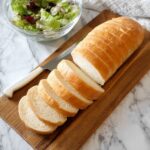
This traditional French Bread recipe produces two crusty, golden loaves with a soft, airy interior. Utilizing active dry yeast and a careful kneading and proofing process, the recipe yields authentic French bread perfect for sandwiches or as an accompaniment to any meal.
Ingredients
Scale
Yeast Mixture
- 2 1/4 ounce pkg active dry yeast (2 packages total)
- 1/2 cup warm water
- 1 tsp granulated white sugar
Dough
- 7 1/2 cups all-purpose flour (divided)
- 1 tbsp salt
- 2 cups warm water
Topping
- 1 large egg white
- 1 tbsp water (for egg wash)
- 1/2 cup cornmeal (for baking sheet)
Instructions
- Activate Yeast: Combine 2 packages of active dry yeast and 1 tsp of granulated white sugar in 1/2 cup of warm water. Set aside until foamy and bubbly, indicating the yeast is active.
- Prepare Dough Base: In a large bowl, mix 1 tbsp salt with 2 cups of warm water. Stir in 2 cups of all-purpose flour and beat well to combine thoroughly.
- Combine Yeast and Dough: Stir the foamy yeast mixture into the flour mixture, then gradually add 4 to 4 1/2 additional cups of flour to form a soft dough that holds together but is not too stiff.
- Rest the Dough: Turn the dough out onto a lightly floured surface, cover it loosely, and let it rest for 10 minutes to allow gluten to relax and ease kneading.
- Knead the Dough: Knead the dough on a floured surface for about 7 to 10 minutes until it becomes smooth and elastic. During this process, incorporate the remaining 1 cup of flour as needed to prevent stickiness.
- First Rise: Place the dough in a lightly greased bowl, turning once to coat all sides. Cover and let it rise in a warm area until the volume doubles, approximately 1 to 1 1/2 hours.
- Punch Down Dough: Gently deflate the risen dough by punching it down and then turning it out onto a lightly floured surface.
- Divide Dough: Cut the dough into two equal portions for two loaves.
- Second Rest: Cover each dough portion and allow to rest for another 10 minutes to relax the gluten before shaping.
- Shape Loaves: Roll each portion into a 15 x 12-inch rectangle. Starting from the long side, roll tightly to form the loaf shape, sealing the edges well and tapering the ends for a traditional French loaf appearance.
- Prepare Baking Sheet: Place each loaf seam-side down on a greased baking sheet sprinkled with cornmeal to prevent sticking.
- Score Loaves: Using a very sharp knife, slash the tops of the loaves every 2 1/2 inches to a depth of about 1/4 inch to allow expansion during baking.
- Make Egg Wash: Beat one large egg white until foamy and mix in 1 tbsp water. Brush this mixture gently over the tops and sides of the loaves to promote browning and shine.
- Final Proof: Cover the loaves with a damp cloth draped over supports so it doesn’t touch the dough. Let them rise until doubled in size, about 1 1/2 hours. Preheat the oven to 375°F (190°C) as this final proofing completes.
- Bake First Phase: Bake the loaves in the preheated oven for approximately 20 minutes until the crust starts to turn light brown.
- Reapply Egg Wash: Remove the loaves and baste again with the egg white mixture to enhance browning and gloss.
- Bake Second Phase: Return to the oven and bake for an additional 20 minutes. If the loaves brown too quickly, loosely cover with foil to prevent burning.
- Cool: Remove the bread from the oven and transfer to a wire rack. Allow to cool completely before slicing to ensure the interior sets properly.
Notes
- Ensure water temperatures are warm, not hot, to avoid killing the yeast.
- Use a very sharp knife for scoring to avoid deflating the dough.
- Resting the dough between steps helps develop gluten for a better texture.
- Brushing with egg white mixture creates a shiny, crisp crust.
- Allow the bread to cool completely for best slicing results and crumb texture.
- Cornmeal on the baking sheet prevents sticking and adds texture to the crust base.